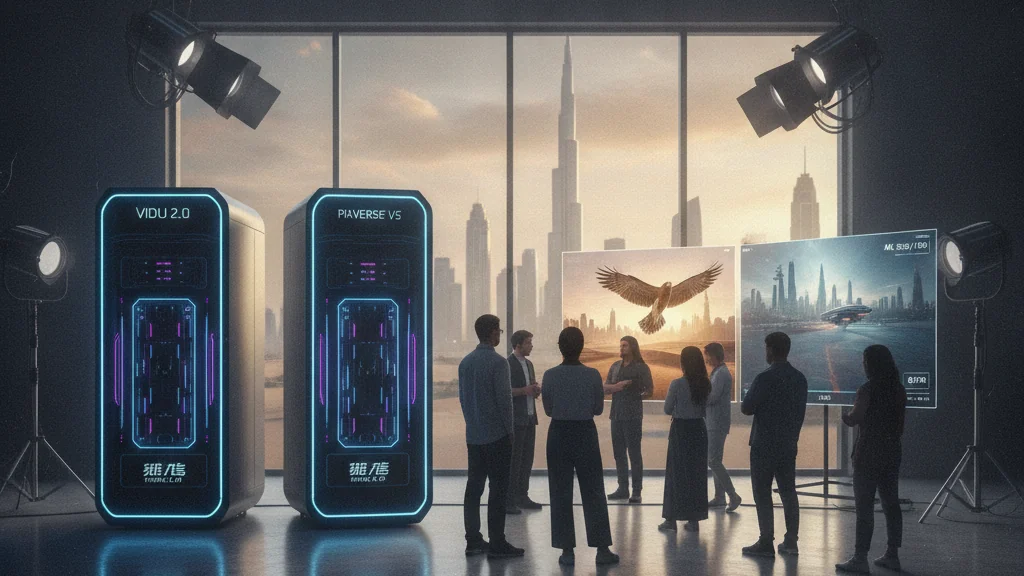
Why Chinese AI video models matter to Dubai production houses in 2026
Atlantis The Royal needed a 60-second bilingual hero film last quarter; the brief landed on a Friday, the agency had four days, and the on-site shoot was already over budget. Two weeks later, a sister hotel group briefed the same scope and finished the spot entirely with AI-generated plates. That is the gap Vidu 2.0 and PixVerse V5 are opening for Dubai production teams in 2026, and it is exactly the kind of signal production leads in DMC and Studio City now track weekly. This is not just about quick social clips anymore. The arrival of 4K, 60-second outputs reshapes everything from brand campaigns in Downtown to architectural visualizations in Business Bay. For years the idea of AI generating broadcast-quality video felt like a distant sci-fi concept; with the latest generation of Chinese-built models it is becoming a tangible reality, and Dubai's production houses, long known for adopting cutting-edge technology, are positioned to be early adopters reshaping how content is created and budgeted for the UAE market.
The rise of Chinese AI in video production
China has been quietly but aggressively investing in AI research and development, and the video generation space is where some of the most impressive results are emerging. Vidu 2.0, developed by Tsinghua University and Shengshu Technology, and PixVerse V5, from a similarly well-funded startup, are leading the charge. These models are not just generating abstract art; they're producing coherent, stylistically consistent video clips with increasing detail and realism. Variety has covered how Shengshu's Vidu platform partners with Honor to push image-to-video generation onto consumer smartphones, and similar coverage tracks how PixVerse has been signing Hollywood-tier pilots across animation and tourism sectors.
What makes these particular models so relevant for Dubai's production sector? It's their focus on longer, higher-fidelity outputs. Current AI models often struggle with temporal consistency and resolution beyond a few seconds. Vidu 2.0 and PixVerse V5 are specifically targeting that 60-second mark at 4K resolution, which is the sweet spot for many commercial and corporate video needs. Imagine a real estate developer in Jumeirah needing a quick, high-quality promo for a new villa compound, or a fashion brand in DIFC wanting to visualize their latest collection without the complexities of a full-scale shoot. The implications are significant. For a broader look at how AI is transforming creative processes, consider our article on AI video trends in 2025.
What 4K, 60-second AI output means for Dubai's production workflow
The ability to generate 4K, 60-second video with AI could fundamentally alter pre-production and even production phases. For agencies in Al Quoz or JBR, this means faster concept visualization for clients. Instead of storyboards and animatics that take days or weeks, a high-fidelity AI-generated preview could be created in hours. This speeds up client approvals and allows for more iterative creative processes.
Consider a scenario where a brand wants to test multiple visual styles or product placements. Traditionally, this would involve costly reshoots or multi-day post-production. With advanced AI video production Dubai, multiple versions can be generated and refined quickly, allowing marketers to fine-tune their message before committing to a full production budget. This doesn't eliminate the need for traditional shoots, but it certainly augments and streamlines the creative pipeline, especially for projects with tight deadlines or experimental elements. Brand marketers in Expo City are already requesting pilots built around these capabilities. For a deeper look at how AI is reshaping commercial workflows, read our recent article on Midjourney V2 video for Dubai luxury brand storytelling.
Vidu 2.0 vs PixVerse V5: technical tradeoffs that matter on set
While both Vidu 2.0 and PixVerse V5 extend what 4K 60-second generation can do, they likely have different underlying architectures and strengths. Vidu 2.0, with its academic roots, might prioritize technical fidelity and control over specific parameters, making it attractive for visual effects supervisors or those looking for highly customized outputs. Imagine a complex CGI sequence for a documentary about the Museum of the Future, where specific environmental elements need to be generated with precision. For this kind of work, our CGI & VFX production services could integrate well with AI-generated assets. You can also explore our insights on Dubai production companies adopting AI video tools.
PixVerse V5, on the other hand, might focus on user-friendliness and artistic flexibility, catering more to creative directors or marketing teams looking for quick, aesthetically pleasing results. Perhaps generating a range of abstract background visuals for a music video at the Coca-Cola Arena, or dynamic motion graphics for a corporate presentation in Deira. The competition between these models will drive innovation, ultimately benefiting the end-users working across Dubai's freelance post-production pool.
The key differentiator will be the level of control and consistency. Can these models maintain character consistency across a minute-long clip? Can they accurately render complex lighting scenarios or specific camera movements? These are the benchmarks that will determine their true utility in professional production environments. For agencies that already juggle multi-vendor pipelines, the bar is whether these tools slot in cleanly or force a re-tooling. For insights into related technological shifts, see our post on the future of drone cinematography in Dubai's film industry.
Integrating Vidu 2.0 vs PixVerse V5 into Dubai's production infrastructure
The integration of these advanced AI tools won't be an overnight switch, but rather a gradual evolution. Dubai's production houses already employ sophisticated workflows involving color grading services, motion graphics design, and virtual production studios. AI will become another tool in the arsenal, complementing existing capabilities rather than replacing them entirely.
For instance, AI could generate initial drafts of product shots, which are then refined by human artists. It could also create background plates or digital doubles, significantly reducing the need for costly location scouting or multi-day shoots on set. For projects that would otherwise require aerial sequences inside restricted airspace around Downtown or JBR, AI-rendered plates can stand in for plate work that is slow and expensive to coordinate. This is especially relevant for large-scale projects shot at Sharjah Media City, where bilingual EN/AR hero films are now being briefed to AI vendors alongside traditional DP crews. For further reading on AI's impact, see our article on AI video production in Dubai.
Ultimately, the arrival of Vidu 2.0 and PixVerse V5's capabilities in 2026 marks an inflection point for Dubai's creative industries. Teams that wire these tools into their existing workflows will offer faster turnaround, more iterative creative options, and tighter budgets for clients across the UAE. The question is no longer whether to pilot them, but how quickly your current pipeline can absorb them.