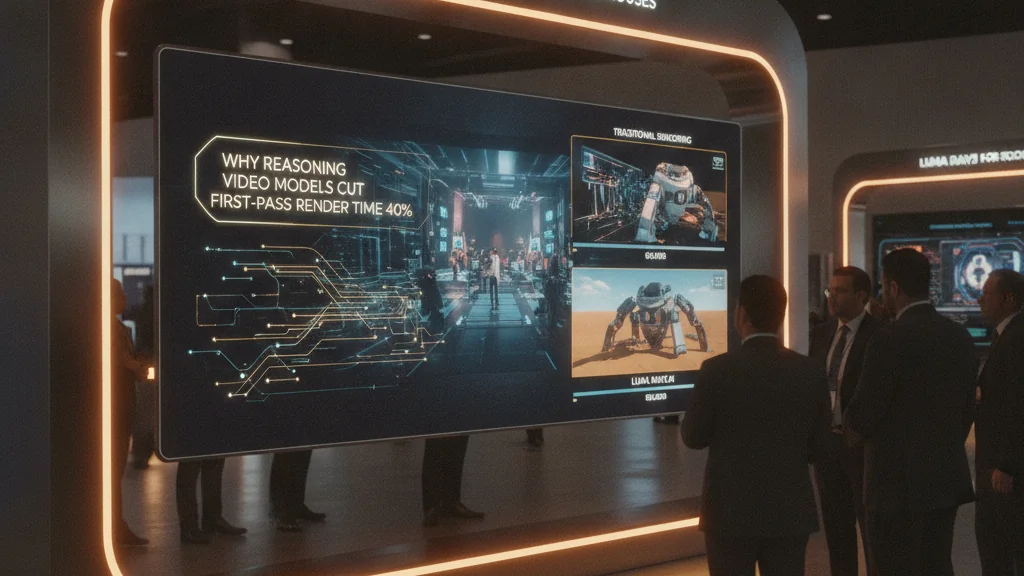
Luma Ray3 Dubai production houses in 2026: why reasoning video models cut first-pass render time 40%
Dubai's production scene is always looking for an edge. From the stunning vistas of the Burj Khalifa to the intricate narratives shot in Al Quoz warehouses, every frame counts. The demand for high-quality video content, whether for brand campaigns in DIFC or immersive experiences at Expo City, is relentless. As we look towards 2026, the discussion isn't just about better cameras or faster editing rigs; it's about fundamentally changing how we approach the post-production pipeline. This is where Luma AI's Ray3, specifically its reasoning video models, becomes a game-changer for Dubai production houses. We're talking about a potential 40% reduction in first-pass render times, a figure that translates directly into significant savings and faster project delivery.
the dubai production landscape and the render bottleneck
Production houses in Dubai, from the established studios in DMC to the agile agencies in Business Bay, face unique challenges. We operate in a competitive market where clients expect world-class output, often on tight deadlines. The steady influx of international co-productions (global brands, regional agencies, and overseas franchises choosing Dubai for its locations and crew depth) adds further pressure to deliver efficiently. Every minute saved in post-production is a minute that can be reinvested into creative refinement or allocated to another project. The biggest bottleneck, historically, has been rendering. Whether it's complex CGI for a luxury real estate walkthrough in Jumeirah or intricate VFX for a major automotive commercial, waiting for renders to complete can eat up hours, sometimes days. This often leads to multiple rounds of revisions, each requiring a full re-render, chewing through budgets and schedules.
Consider a typical scenario we see every week at our Al Quoz suite: a brand marketer for a DIFC-based hospitality group needs a 60-second pre-launch commercial cut for both the Burj Khalifa façade projection and a follow-on Instagram reel. The production involves green screen footage shot on an ARRI Alexa Mini LF, a DaVinci Resolve color-managed grade, motion graphics, and some light CGI integration for the new lobby render. The first cut goes through, the client provides feedback, perhaps a slight change in the product's reflection, or a tweak to the lighting on an animated logo. Each of these seemingly small adjustments triggers a full re-render. With traditional methods, this can be a slow, iterative process. This is where Luma Ray3's reasoning video models step in, promising a more intelligent, predictive approach to rendering — a shift that complements what Runway Gen-4.5 and the broader multi-model stack already unlocked for commercial shoots, and a step beyond the iterative auto-editing wins documented in our Runway Aleph 2.0 post-house benchmark.
what are reasoning video models and how do they work?
At its core, a reasoning video model is an AI system designed to understand the semantic content and temporal relationships within video footage, not just individual frames. Unlike traditional rendering engines that process pixels in a linear fashion, these models can "reason" about the scene. They understand object permanence, light interaction, and motion trajectories. For example, if you have a Genesis GV70 tracking through the dunes outside Al Qudra, the model can infer how late-afternoon Hatta light should realistically rake across the bodywork, how dust lifts off the wheel arches at speed, and how the camera car's shadow falls on the track. This goes beyond simple frame interpolation or upscaling; it's about predicting and generating visually consistent and physically plausible elements within the video.
for reducing render times, this intelligent understanding is paramount. Instead of having to re-render an entire complex scene for a minor adjustment, the reasoning model can selectively re-render only the affected elements and intelligently integrate them back into the existing, largely pre-rendered footage. It's like having an incredibly smart assistant who knows exactly which parts of a painting need touching up, rather than asking you to repaint the entire canvas for a small color correction. This capability is particularly impactful for tasks like CGI & VFX production, where scene complexity often leads to exorbitant render times.
the 40% render time reduction: a practical perspective
Let's break down how a 40% reduction in first-pass render time actually translates on the ground in Dubai. Imagine a project with a total estimated render time of 100 hours for its first complete pass. With Luma Ray3, that could drop to 60 hours. That's 40 hours saved immediately. For a studio in Studio City or Al Quoz, those 40 hours can be redirected. They could be used for additional creative exploration, allowing directors to experiment with alternative shots or visual styles without incurring massive time penalties. They could mean earlier delivery to a client, strengthening relationships and potentially securing future projects. Or, perhaps most critically, they could free up render farm resources for another project, effectively increasing a studio's overall capacity without needing to invest in more hardware.
This efficiency gain isn't just about the first pass. The real magic happens in the revision cycles. If each revision previously took 10 hours for a full re-render, a reasoning model might reduce that to 2-3 hours because it only needs to process the specific changes, not the entire scene from scratch. This drastically shortens the feedback loop, allowing for more iterations and a higher quality final product within the same, or even shorter, timeframe. For high-stakes projects like major brand launches or sell-out events at the Coca-Cola Arena, where deadlines are absolute, this is an invaluable advantage.
integrating luma ray3 dubai workflows: practical steps
Adopting Luma Ray3 won't be an overnight switch, but the benefits make a compelling case for integration. Production houses will need to consider how their existing pipelines, from video production services to color grading services, can interface with these new AI models. Training creative teams to understand the capabilities and limitations of reasoning video models will be key. The focus will shift from brute-force rendering to intelligent asset management and AI-assisted scene construction. This also opens up new possibilities for AI video production Dubai services, where generative AI can assist in creating initial concepts or entire sequences, further streamlining pre-visualization and production.
While the technology is advanced, the user experience is designed to be intuitive. Luma AI is focused on making these tools accessible to artists and technicians, not just AI researchers. The goal is to augment human creativity, not replace it. As the UAE continues its push to be a global hub for innovation, embracing such AI-driven solutions will differentiate production houses looking to stay ahead. For technical context on the underlying AI, sources like the OpenAI blog often provide valuable context on related generative models.
The future of video production in Dubai is undeniably intertwined with AI. Luma Ray3's reasoning video models represent a significant leap forward, promising a fundamental shift in efficiency. For production houses aiming to deliver faster, more creatively ambitious projects while maintaining profitability, understanding and adopting this technology by 2026 will be a strategic imperative. The 40% reduction in first-pass render time isn't just a number; it's a competitive advantage waiting to be seized.