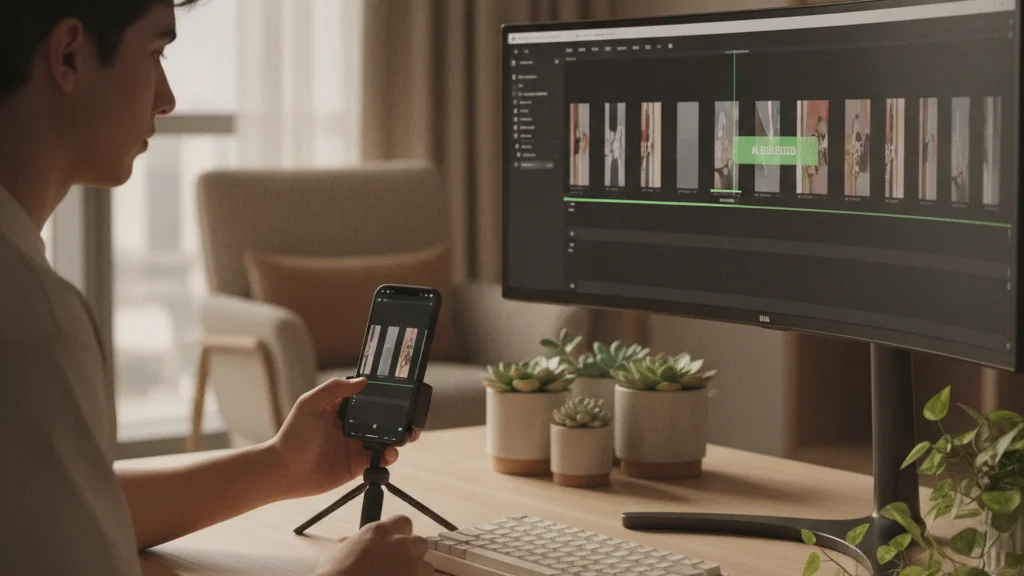
If you run a YouTube channel, you already know the math problem. One long-form video, ten Shorts, zero extra shoot days. Most Dubai creators I've talked to solve it by hiring a freelance editor, cutting corners on captions, or just letting the Shorts pile up unwatched. YouTube's new Auto-Cut feature, which finished its global rollout in June 2026, tries to fix that ratio. It scans your long-form upload, picks the most engaging 30-to-60 second slices, reframes them for vertical, captions them, and hands them back to you inside YouTube Studio. You keep the edit. The AI just does the boring part.
For a city that already runs on content — creators in Dubai Media City, agencies in Business Bay, solo operators in JLT — that shift is bigger than the press release makes it sound.
How Auto-Cut actually picks the clips
Auto-Cut is not a random trim. When you upload a long-form video, the system runs three passes. First, it scores every second of your footage against a "virality" model trained on billions of hours of watch data, looking for high-emotion beats, sharp topic changes, and visual standouts. Second, it picks the top-ranked moments as clip candidates and gives you start-and-end timestamps. Third, it reframes the 16:9 source into 9:16, centers the subject, and burns in captions in one of 13 languages including Arabic.
The interesting part is the framing logic. Older auto-reframing tools crop aggressively and lose faces. Auto-Cut's model was trained on creator footage specifically, so it does a much better job keeping eyes, mouths, and the main action in frame. It still gets it wrong sometimes — fast pans, two-person interviews, sports — but the hit rate is high enough that beta testers stopped manually reframing most of their Shorts.
What the beta numbers actually showed
YouTube published the Auto-Cut beta results in May 2026. The headline number was a 40% lift in Shorts watch time for creators who used the feature, measured against a control group of similar channels that didn't. There are caveats: channels with over 100,000 subscribers saw a bigger lift, and the effect was strongest on interview and podcast-style content where the AI could identify clear soundbites.
The less-reported number was time saved. Creators who previously spent two to three hours per long-form video turning it into Shorts reported getting that down to under thirty minutes of review-and-publish work. For a Dubai-based creator juggling client work, brand deals, and a personal channel, that's not a small efficiency. That's the difference between posting five Shorts a week and posting twelve.
What this looks like for Dubai creators
Three workflows make the most sense right now.
The bilingual repurposer. If you film in English but want Arabic Shorts (or the other way around), Auto-Cut's built-in captioning and language detection means you can publish the same clip in two languages with separate titles and tags. That's been a manual pain point for years. Auto-Cut doesn't translate the audio, but the captions are accurate enough to act as a base layer for an Arabic-speaking editor to clean up.
The agency batch workflow. Studios in Dubai Media City running multiple client channels can now produce Shorts for ten clients in the time it used to take to do three. The clip candidates are good enough that a junior editor can review, tweak, and schedule them in an afternoon. You don't need a senior colorist on Shorts work anymore, which is a real cost saving on retainer-based accounts.
The solo creator doubling output. This is the one that matters most. A solo YouTuber shooting in Business Bay, editing at home, and trying to keep a daily Shorts presence was previously running on fumes. Auto-Cut gets you closer to "post one long-form video, get a week of Shorts out of it" without a second person in the workflow. Understanding how this fits into the broader YouTube algorithm in 2026 matters: the algorithm rewards consistent Shorts output, and consistency is the one thing most solo creators struggle to maintain.
Where Auto-Cut falls apart
It is not magic. There are four cases where you should ignore the suggestions entirely.
Long monologues that build to a point. If your entire 20-minute video is one slow build to a single insight, Auto-Cut will chop it into five confusing fragments. The AI doesn't understand narrative arc. It just scores emotional spikes.
Sponsored reads and brand integrations. Auto-Cut will happily cut a 90-second sponsored segment into a 30-second Short that drops the brand name and the legal disclosure. That's a compliance problem and a relationship problem. Always handle sponsored content manually.
Cultural moments that depend on context. A joke that lands only because of a running reference, a callback to something you said two videos ago, a regional reference that needs setup — the AI has no idea. It'll happily cut the setup and leave the punchline. Review every clip.
Two-person interviews and podcasts with overlapping speech. The reframing logic still struggles when there are two faces. It often crops to the wrong person, or to neither.
For Dubai creators in particular, the cultural context point is the one to watch. Auto-Cut is trained mostly on English-language watch data. MENA-specific humor, Arabic idiom, references to local events — these won't score highly on the virality model even when they're the most engaging moments for your actual audience.
How to shoot for Auto-Cut
The smart move is to design your long-form videos knowing the AI will mine them. Five things help.
- Plant standalone moments. Open sections with a question, a strong claim, or a clear visual. These score high on the virality model and make for clean Shorts.
- Leave headroom in the frame. If you crop tight during filming, the AI has nowhere to reframe. Shoot slightly wider than you would for a final cut.
- Use clean, short sentences. Auto-Cut's captions work best when the source audio has clear sentence breaks. Run-on sentences turn into run-on captions.
- Mark your sponsored bits. Say "and a quick word from our sponsor" out loud. The AI will still flag the segment, but you can spot it faster in the review queue.
- Post a vertical reference version. If a moment is going to be a Short, film a second take in 9:16 with the same framing. Use the Auto-Cut version as a draft, then swap in your vertical take for the final.
This is a short-form video strategy shift as much as a tool shift. The creators who get the most out of Auto-Cut are the ones who design their long-form videos around the assumption that every minute of footage is also Shorts material. YouTube's creator signal updates are pushing the same direction — the algorithm is rewarding channels that treat long-form and Shorts as one content system, not two.
The wider picture
Auto-Cut is part of a broader push by YouTube to make Shorts the default growth surface. The platform has said publicly that Shorts drive a large share of new channel subscriptions in the MENA region, and the bet is that anything that lowers the friction of producing Shorts will pull more creators (and more ads) onto the platform. According to YouTube's own creator growth data, channels that post Shorts alongside long-form see measurably faster subscriber growth than long-form-only channels.
For Dubai-based agencies and production companies, the practical question is whether to fold Auto-Cut into client deliverables. Most of the larger studios are already doing it on a trial basis. The smaller ones are using it as a way to offer a "Shorts package" add-on at a lower price point than full video production. That last point is worth pausing on: it compresses the market. A creator who would have paid a Dubai agency AED 4,000 for a 30-second Short can now get something serviceable for free, in fifteen minutes, on their own. The agencies that win long-term are the ones offering something Auto-Cut can't — creative concept, on-camera talent, motion graphics, platform-native humor, regional insight.
The bigger story is what AI in creative tooling keeps showing us: the tools that "replace" creative work mostly just move the line up. The bar for "good enough" rises, and the value of taste, judgment, and point of view rises with it. Auto-Cut won't replace the creators who already know what they're doing. It will replace the people whose only job was the mechanical cut.
If you're a Dubai creator who has been avoiding Shorts because of the time cost, this is your moment to start. Upload a long-form video, let Auto-Cut pick the candidates, and spend thirty minutes picking the three best. Post them. See what happens. The worst case is you wasted half an hour. The best case is you've just bought yourself back a few hours a week to spend on the long-form work that actually grows your channel.
For broader context on short-form video performance, Wyzowl's annual video marketing statistics track Shorts and vertical video trends across thousands of marketers.
For projects that need hands-on creative direction plus the speed of generative tools, our AI video production studio in Dubai covers the full pipeline from brief and storyboard through generation, review, and finishing.