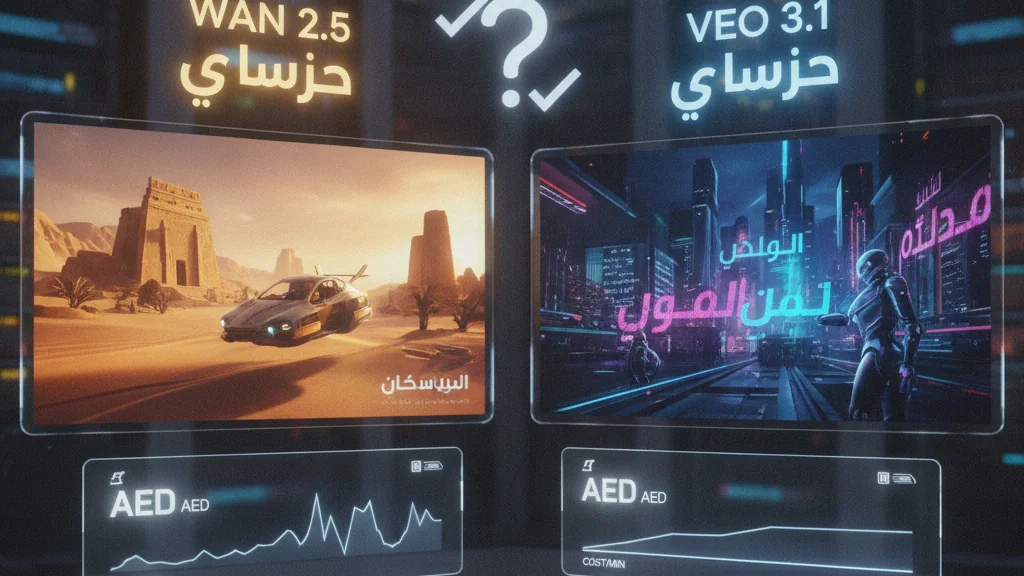
Why Dubai Marketers Are Watching AI Video Models Closely
Dubai's marketing and production scene is always on the lookout for an edge. As we move into 2026, the discussion around AI video generation for Arabic advertising is sharpening, particularly when comparing models like Wan 2.5 and the newer Veo 3.1. For production teams in DIFC; brand marketers in Business Bay; and agency owners in Dubai Marina, the critical questions revolve around output quality, cultural nuance, and, of course, the bottom line in AED.
Traditional video production in Dubai, with a multi-day shoot in Al Quoz or Studio City, can easily run from AED 35,000 to AED 60,000 for a 30-second spot. AI offers a compelling alternative if the quality meets the high standards expected in the UAE market.
Understanding the Models: Wan 2.5 vs. Veo 3.1 for Arabic Content
Wan 2.5, while a solid performer in its earlier iterations, has been a workhorse for generating diverse video content. Its strength often lies in its ability to produce consistent character models and environments, which is vital for brand continuity. For a corporate explainer video targeting fintechs in DIFC, Wan 2.5 has offered a reliable, if sometimes generic, visual style.
Veo 3.1, on the other hand, represents the next generation of Google's video generation capabilities. Early reports and hands-on testing suggest a significant leap in photorealism, motion complexity, and understanding of natural language prompts. This is crucial for Arabic advertising, where subtle cultural cues, fluent body language, and authentic expressions are paramount. Imagine an AI-generated ad for a luxury automotive brand at Dubai Studio City. Veo 3.1's ability to render nuanced reflections and textures could be a game changer compared to Wan 2.5's often flatter aesthetic. For more technical details on Veo, you can refer to Google's official announcement.
The pipeline for both involves detailed text prompts, often incorporating style references, character descriptions, and scene settings. For Arabic content, the challenge isn't just generating the visuals, but ensuring the generated actors and environments resonate culturally. This includes appropriate attire, gestures, and even the subtle architectural details of a Jumeirah villa or a Deira Souk. While both models are improving, Veo 3.1 shows greater promise in capturing these intricacies without requiring extensive post-production VFX work, which can add significant cost and time. For more on the specifics of this process, see our post on AI video tools in 2026.
Quality Metrics: Photorealism, Cultural Nuance, and Lip-Sync for Arabic Voiceovers
When we talk about quality for Arabic video ads, several factors come to the forefront. Photorealism is non-negotiable for Dubai's discerning audience. Early AI models often suffered from "AI uncanny valley" effects, particularly with human faces and fluid motion. Veo 3.1 appears to mitigate this more effectively than Wan 2.5, producing more believable human subjects and dynamic camera movements. This is especially important for ads featuring people, such as those for off-plan real estate in Dubai Marina or tourism campaigns for Expo City.
Cultural nuance extends beyond just visual accuracy. It encompasses the overall tone, the implicit understanding of social interactions, and the subtle emotional expressions that are vital for connecting with an Arabic-speaking audience. For a hospitality brand filming a Ramadan campaign around the Burj Al Arab or a family destination near Kite Beach, for instance, the AI-generated content needs to convey warmth, modesty, and regional familiarity. While Wan 2.5 can be prompted for specific cultural elements, Veo 3.1's advanced understanding of context, driven by larger and more diverse training datasets, often results in more authentic and less stereotypical portrayals.
Lip-sync accuracy for Arabic voiceovers is another critical area. Integrating high-quality AI-generated Arabic voiceovers from services like ElevenLabs (which offers advanced Arabic V3 enterprise pricing) with AI-generated visuals requires precision. Wan 2.5 often requires more manual adjustment in post-production to achieve acceptable lip-sync, increasing the overall cost. Veo 3.1, with its improved temporal consistency, shows potential for more accurate and natural-looking lip movements, reducing the need for extensive CGI & VFX production.
AED Cost Implications: Wan 2.5 vs Veo 3.1 vs Traditional Dubai Production
Cost is always a primary driver for businesses in the UAE. Both Wan 2.5 and Veo 3.1 operate on subscription or usage-based models. While specific 2026 pricing for Veo 3.1 is still emerging, it's expected to be competitive with other high-end AI video generators like Runway Gen (currently around $76/month for basic tiers) or Sora Pro ($200/month for advanced access). Wan 2.5 typically offers tiered pricing, with enterprise solutions available for heavier usage.
The real cost savings come from reducing the need for physical shoots, talent fees, location permits (DCAA permits for drone videography Dubai can add to expenses), and extensive post-production. For a Dubai-based SME needing multiple ad variants for a new product, generating 8-10 variations with an AI model for a few hundred dirhams is far more economical than a traditional crew call: a one-day Studio City shoot with a DP, AC, gaffer, two talent, and grip truck typically clears AED 22,000 to AED 45,000 before any retouching. We have seen this comparison unfold across our 2026 Dubai studio guide to AI video pipelines, and the AED math holds up across hospitality, retail, and real estate briefs. However, these tools are part of a pipeline. A production team will still need expertise in prompt engineering, storyboarding, script development, and final color grading services and motion graphics design to polish the AI-generated output.
Our AI video production Dubai services often involve a hybrid approach, combining AI generation with human oversight to ensure brand safety, prevent model collapse, and address any hallucinated text or logos that AI models can sometimes produce. This ensures the final deliverable meets the exacting standards of clients in Downtown Dubai or JBR.
Production Efficiency and Future Outlook for Dubai's Creative Sector
The speed at which AI models can generate video assets is unparalleled. This efficiency is particularly valuable in the fast-paced Dubai market, where campaigns often need to go live quickly. For virtual staging of real estate projects or rapid prototyping of ad concepts, AI offers a significant advantage. Imagine generating multiple concept videos for a new development near the Museum of the Future in hours, rather than weeks.
Veo 3.1's potential for higher fidelity and better contextual understanding suggests it will lead to fewer iterations and reduced refinement needed in post-production. This directly translates to cost savings and faster turnaround times. For production teams across the UAE, that means more dynamic content delivered within tighter campaign windows, without compromising on the polish clients expect in DIFC boardrooms or Downtown Dubai launches.
As the technology matures, we anticipate even greater integration with virtual production studio environments and specialized tools like Topaz Video AI for upscaling and DaVinci Neural Engine for color correction. The competition from other AI players like Luma AI, Krea AI, and Synthesia will continue to drive innovation, pushing both Wan and Veo to deliver even more impressive results for the UAE's advertising environment.