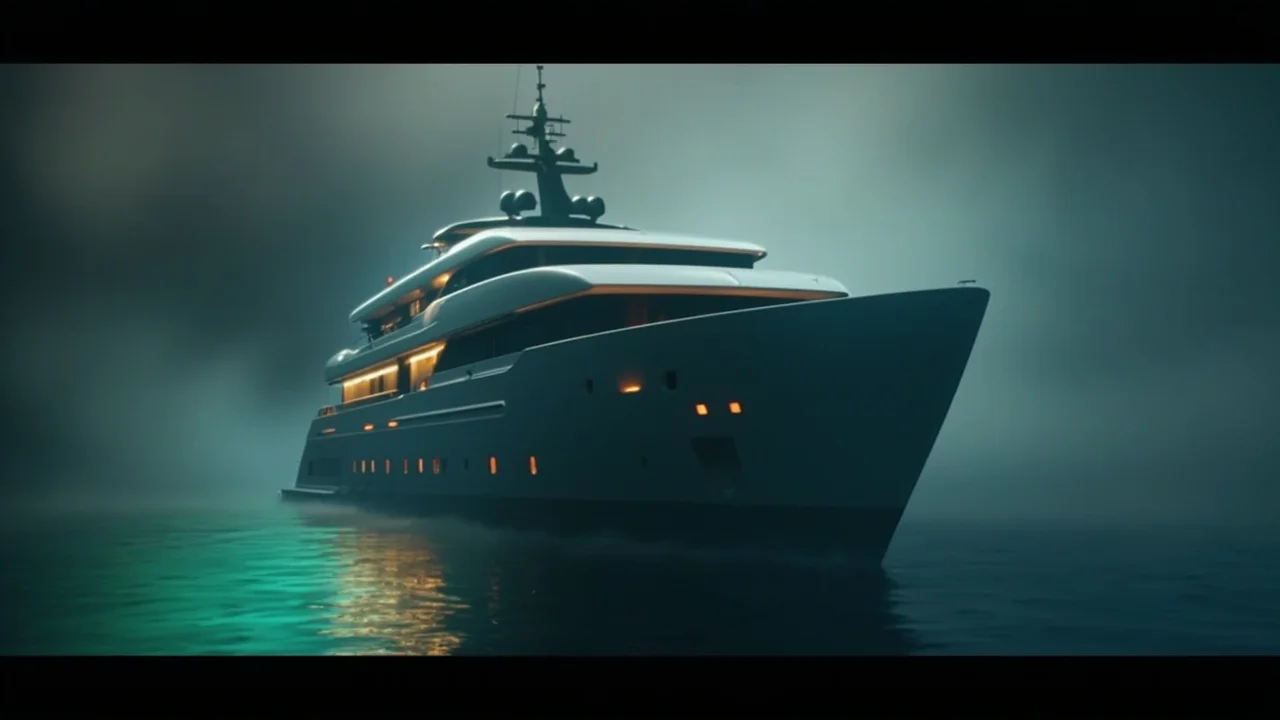
LED volume vs pure AI video for a Dubai luxury yacht reveal in 2026
A yacht reveal sells two things at once: the vessel itself and the lifestyle around it. A Dubai team might stage the cabin on an LED volume, generate a fictional marina in AI, or combine both with real footage shot around Dubai Marina and JBR.
The short answer for 2026 is that an LED volume delivers the most controllable premium result when the budget supports a physical crew and live photography. Pure AI video offers exceptional speed and visual range at a lower cost, but it remains risky for extended yacht sequences where hull geometry, reflections, water movement, and brand details must remain consistent. For most luxury marine launches, a hybrid approach gives clients the safest balance of credibility and spectacle.
Defining the three production approaches
An LED volume is a real camera stage enclosed by high-resolution LED walls. Operators can change the environment between shots while retaining natural perspective, depth, and moving reflections. Dubai studios around DMC, Studio City, Sharjah Media City, and the Media City Free Zone increasingly offer this format for automotive, hospitality, and product campaigns.
Pure AI video creates the yacht, environment, camera move and lighting without filming a live-action set. It can produce a sunset departure, an underwater cabin visualisation, or a superyacht emerging through a futuristic skyline. It also works for previsualisation and concept films before a physical shoot is approved.
A hybrid production uses real footage for the yacht and critical detail shots, AI for environments or impossible transitions, and an LED volume for controlled studio sequences. This is often the most practical option for a launch needing both luxury and technical precision. Agencies offering AI video production Dubai services can produce convincing concept sequences quickly, though a premium reveal still benefits from authentic photography.
What a Dubai yacht reveal costs in 2026
Indicative planning bands for a 30- to 60-second launch film place a short LED-volume package at approximately AED 55,000 to AED 120,000. That includes stage rental, content creation, camera and tracking setup, lighting, playback, and a basic crew. A full campaign combining the stage with a one-day yacht shoot can rise to roughly AED 100,000 to AED 220,000, especially if the schedule includes aerial coverage or premium waterfront access.
A pure AI package can be delivered for approximately AED 8,000 to AED 30,000, depending on the number of shots, resolution, duration, sound design, revisions, and the extent of compositing. It is the fastest and most cost-efficient route, but lower production cost does not remove the expense of correcting continuity errors, malformed fittings, unstable logos, or incorrect yacht proportions.
Hybrid budgets fall between AED 25,000 and AED 60,000 for digital extensions and supporting films, before live-action production. A realistic yacht day with camera crew, marine coordinator, drone team and location fees may start around AED 35,000. Landmarks such as the Museum of the Future and Expo City work as visual references rather than mandatory locations.
Location premiums vary across Dubai Marina, Downtown, Jumeirah, Business Bay, DIFC and Al Quoz. A stage avoids marine logistics, but a real marina gives genuine scale, sunlight and wake that are hard to reproduce.
Where LED volume quality wins over pure AI video
LED production keeps the yacht physically in front of the camera. Crew can inspect paint depth, chrome finishes, upholstery, timber grain and screen reflections directly. Camera tracking also gives a repeatable path for smooth reveal moves, from the bow to the saloon.
The visual value is strongest when the virtual background is believable and properly calibrated. Poor brightness matching can flatten the yacht, while visible LED pixel structure, moiré, black crush, or tracking delay can ruin a luxury finish. Studios without experienced technical directors may also underestimate power, cooling, colour calibration, and media-server requirements.
The pipeline is proven for high-end commercial work. JJ Agency Films explains how virtual production with LED volumes in Dubai can replace conventional green-screen workflows through real-time Unreal Engine environments and accurate in-camera reflections. The wider cost question is covered in its comparison of an LED stage and a real Dubai location for luxury campaigns.
Where LED volume vs pure AI video swaps places
AI gives a yacht brand something a practical set cannot: complete visual freedom. The camera can move underwater, pass through the hull, rise above a fictional archipelago, or reveal the vessel inside a luminous virtual showroom. Such shots make a launch film feel like a premium campaign rather than a specification video.
Experimentation is cheaper too. A team can generate multiple marina concepts, weather options and campaign lines before committing to a physical shoot. That suits hospitality, tourism, retail and real-estate brands.
However, yachts expose weaknesses that generic AI examples conceal. AI may alter the number of windows, curve a hull incorrectly, change a logo between frames, or make anchor chains behave like flexible objects. Water can pass through the hull, and long shots increase temporal drift as details subtly change.
Models have improved considerably. The comparison between Vidu 2.0 and PixVerse V5 for Dubai production houses illustrates how systems are moving toward longer, higher-resolution output. Reporting from Variety’s artificial intelligence coverage tracks the rapid development of commercial AI filmmaking tools.
Choosing the right method for each yacht reveal shot
For the hero exterior, practical photography is usually the strongest choice. A drone pass around a real yacht communicates scale more convincingly, particularly with the Dubai skyline behind it. An LED stage can support this if the studio has an accurate environment and lighting team, but it cannot add genuine atmospheric variation outside the captured environment.
For the saloon, bed configuration, galley and materials, practical or LED capture gives the brand precise control. AI can extend a real cabin into an ocean setting, but close-ups of stitching, veneer and branded objects should stay photographed.
For underwater sections, abstract hull cutaways, imaginary destinations, and conceptual future concepts, AI is highly effective. A disciplined workflow should use approved yacht geometry as a visual reference, create character and colour locks, and limit the final film to shots that can be reviewed at full resolution.
The final recommendation depends on campaign objective. A six- to twelve-second social teaser for a real-estate launch or marina operator may justify pure AI. A corporate film showing a new yacht to brokers, clients, or charter guests needs real photography. A global reveal that combines the vessel with dramatic imaginary locations will usually perform best as a hybrid.
The 2026 production recommendation for Dubai studios
For a high-budget luxury yacht reveal, choose LED volume when precise reflections, live camera movement, premium lighting and a repeatable shoot matter more than speed. Choose pure AI for concept films, teasers, social content, and scenes where physical accuracy carries little weight. For the main launch film, retain practical yacht footage and add AI only where it creates genuine narrative or commercial value.
This keeps the vessel believable while giving Dubai teams room to build memorable worlds, and protects the brand from continuity defects that make polished AI feel artificial. The strongest 2026 yacht campaign is rarely the one with the most generated footage, but the one where every technique does the job it was selected for.