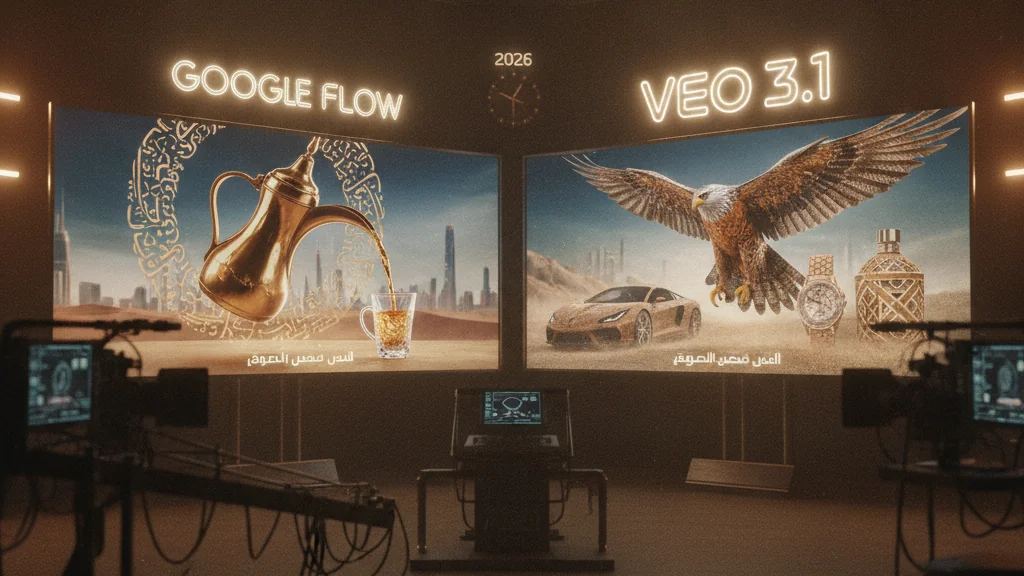
Google Flow vs Veo 3.1 for Dubai production houses in 2026
A Dubai product spot shot in Arabic has to clear three bars at once: correct Arabic on-screen text, a stable product in frame, and a delivery timeline a client will accept. In 2026 the conversation usually lands on Google Flow and Veo 3.1. The first thing to clear up is that these are not two competing models. Google Flow is Google's filmmaking interface, a scene-building workspace where a creative team assembles shots, camera moves, and references into a sequence. Veo 3.1 is one of the generation models that Flow can call, and it is also the same model a production house can invoke directly through the Veo API on Vertex AI, as Google's own Veo model documentation sets out. So the real question for a brand in Downtown, JBR, or Business Bay is not which tool wins, but where in your pipeline you want to sit: inside Flow's guided workspace, or on the raw model behind it.
Google Flow vs Veo 3.1 on the Arabic language challenge
The generation layer underneath, Veo 3.1, draws on Google's language and audio training data, which is where most of the idiomatic range comes from. It tends to hold colloquial Gulf phrasing and on-screen Arabic text more consistently than earlier Veo versions, and it is the part of the stack that carries the actual Arabic voiceover. The practical difference between running Veo 3.1 inside Flow and running it through the API is control over the timeline: Flow's scene graph lets a director block a shot, adjust the camera move, and extend the take in one canvas, while a direct API call hands you parameters but no staging layer.
Veo 3.1's own strength is temporal coherence. It holds subject detail and motion stable across a continuous take, which matters when a jewelry brand in DIFC wants to display a new collection without the product drifting between frames. The trade-off teams hit is prompt sensitivity: nailing the emotional depth of an Arabic voiceover often takes more prompt iterations than locking the visual continuity of a product shot, which is why Flow's iterative canvas tends to pay off on the voiceover pass and a script-first API workflow tends to pay off on the picture pass. For a deeper dive into how different AI models stack up against each other for Arabic ads, consider the analysis on WAN 2.5 vs Veo 3.1 for Arabic Video Ads.
Veo 3.1 and Google Flow visual fidelity for Dubai's luxury market
Dubai is synonymous with luxury, and product videos here demand exceptional visual quality. Veo 3.1 generates up to 4K, which is where most Dubai product deliverables sit. For real estate developers showing off-plan properties in Al Quoz or Dubai Marina, crisp, detailed visuals are non-negotiable. Because Flow renders through the same Veo 3.1 model, the texture and lighting quality is identical whether the shot was staged inside Flow or generated through the API, and the same asset can then be staged against a property model without leaving the workspace.
What does differ is the grade and the frame around the image. Veo 3.1 is generally recognised for a more filmic look and feel, which can be ideal for high-end fashion brands or automotive commercials shot around Expo City. The subtle depth of field and natural motion blur generated by Veo 3.1 can improve a product video from good to outstanding. While a traditional 3-day studio shoot for a luxury car commercial might cost upwards of AED 60,000, using AI models like Veo 3.1 can produce multiple high-quality variants for a fraction of that, with subscription costs for advanced tiers often in the range of $200-$500 per month. For more on AI video models reaching Dubai, check out Vidu 2.0 vs Pixverse V5: Chinese AI Video Models Reach Dubai Production Houses.
Workflow integration and post-production efficiency in Flow and Veo 3.1
For busy production teams in Dubai Media City (DMC) or Studio City, integrating AI tools into existing workflows is paramount. Google Flow, being part of the broader Google ecosystem, often offers straightforward integration with other Google Cloud services, which can streamline data management and asset sharing. Its user interface is generally intuitive, making it accessible for creative professionals who might not be deep learning experts. Post-production tasks like AI upscaling, color grading, and even some basic VFX can be expedited.
The direct Veo 3.1 API, developed by Google's DeepMind team and served through Vertex AI, caters to a slightly more technically inclined user base and offers more granular control over generation parameters. That granularity is useful for fine-tuning specific aspects of a product video, such as camera movements or object interactions, and for complex projects involving CGI or detailed motion graphics where clean, consistent base footage is invaluable. For projects with heavy post-production, generating clean, consistent base footage from either route is what saves the most time in Resolve, and for teams running larger campaigns the AI content production service route covers the same pipeline end to end. You can find more insights on cost comparisons between virtual and traditional production in Dubai by reading about Virtual Production Cost in Dubai 2026.
The future of Arabic product videos with AI
As 2026 unfolds, both Google Flow and Veo 3.1 will continue to evolve. The demand for hyper-localized, culturally sensitive Arabic content will only grow, driven by brands in sectors like retail, education, and tourism. For a fintech company in DIFC, an AI-generated explainer video in Arabic can quickly communicate complex financial products. For a major event at the Coca-Cola Arena, AI-driven promotional videos can be rapidly adapted for various audience segments.
The choice between running Veo 3.1 inside Flow or calling it directly usually comes down to the shape of the job. If authentic Arabic voiceovers, rapid shot iteration, and a director who wants to block scenes visually are the priorities, Flow is the faster route. If parameter-level control, batch generation across dozens of product variants, or piping renders straight into an existing Resolve or Nuke pipeline are the priorities, the Veo 3.1 API is the leaner route. Many Dubai production houses are finding success by using Flow for the creative pass and the API for the production pass, which keeps the look consistent while removing per-shot clicking. Both routes are moving quickly, and the gap between them is narrowing on workflow rather than on image quality. For a Dubai team, the practical move is to run one 30-second spot through each route in a single sitting and compare the finished deliverable, not the interface.