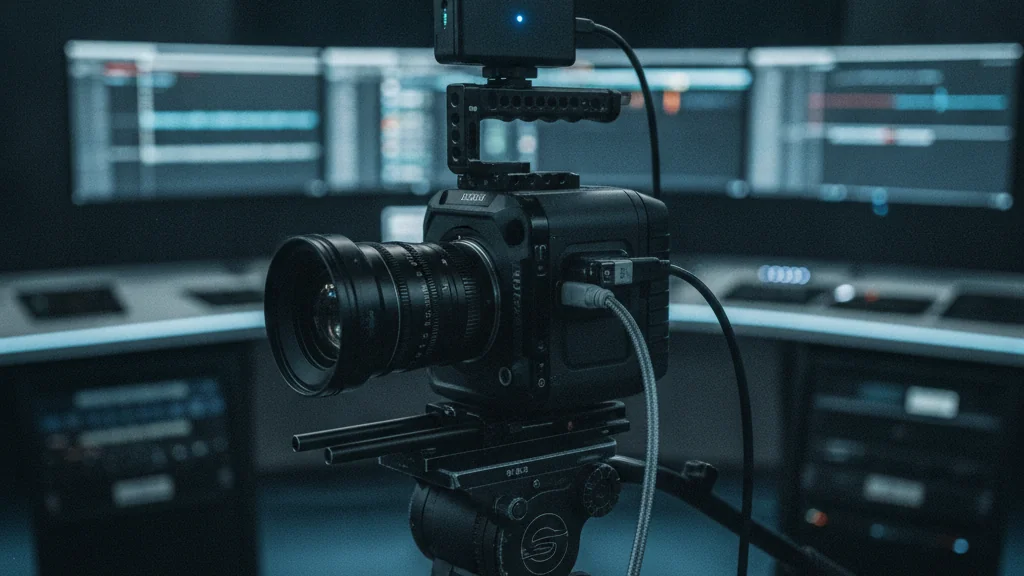
Camera to Cloud sounds like marketing hype until you watch an editor in Al Quoz cut a scene that was shot in the desert twenty minutes ago. That is what Frame.io C2C now offers, and with native support inside the RED KOMODO-X and the latest DJI bodies, the technology has stopped being a clever demo and started being a workflow Dubai post houses actually run.
What C2C actually does
Frame.io's Camera to Cloud uploads proxies, or in some setups full-resolution files, from the camera to a shared cloud project the moment a clip is recorded. Editors, colorists, and clients can open Frame.io from anywhere and start working with the same footage the operator just saw on the monitor. The old model, where a DIT offloads cards at the end of the day, generates proxies overnight, and hand-delivers a drive to the edit suite, gets compressed into minutes. The cards still come off the camera, and they should, but the post team no longer has to wait.
RED KOMODO-X and DJI get native support
The shift to mainstream happened when the cameras most Dubai productions already use gained first-party C2C. The RED KOMODO-X now sends proxies over Wi-Fi or Ethernet straight to a Frame.io project without an extra box bolted to the rig. For commercials and branded content shot around Dubai Marina, Downtown, or the desert, that means an editor in Media City can be cutting selects before the camera truck has left the gate of the location.
DJI's Ronin 4D and the Inspire 3 now do the same thing. The Inspire 3 in particular matters here, because aerial work is half of any real-estate, hospitality, or tourism brief in the UAE. Uploading proxies from the drone to Frame.io while it is still packed in its case means the colorist can start matching grades to existing scenes within the hour. If you are not sure what your drone team can legally fly, our Drone Cinematography in Dubai: Rules, Permits, and Creative Possibilities guide covers the 22 no-NOC zones and the DCAA approval flow.
Why Dubai post houses care
Dubai post is competitive, fast, and increasingly remote. C2C fits the way these studios already work, and removes friction from three places at once:
- Turnaround: Editors can begin a rough cut during the shoot day, not after it. For corporate clients who want a social cut before the brand cut, this collapses a two-day lag into a two-hour lag.
- Remote review: Producers in twofour54, clients in DIFC, and a freelance colorist working from London can all pull the same proxies into Frame.io and leave timestamped comments. This is the same logic behind Cloud-Based Video Editing: Why Dubai Studios Are Going Remote, applied at the dailies stage instead of the timeline stage.
- Less DIT overhead: You still need a DIT, but the job changes. Instead of babysitting offloads all evening, the DIT handles QC, slate sync, and connection health. For a full-service video production house that bills by the day, that is real money.
A real Dubai shoot on C2C
A luxury hotel brand wants a 60-second hero spot plus nine social cuts. Two days of shoot across the Palm, the Burj Khalifa district, and a desert camp, with a KOMODO-X for the interiors and an Inspire 3 for the aerials. On the old workflow, the editor gets the cards on day three, proxies on day four, and the first rough cut is reviewed on day five. The agency is asking for delivery in ten working days, and there is no slack.
With C2C, the editor is pinging comments into Frame.io by mid-afternoon of day one. The director, on set, watches the rough cut take shape on a tablet during lunch. The brand manager at the hotel's marketing office in Business Bay opens the Frame.io link, drops a single comment ("warmer grade on the desert plate"), and closes the laptop. By the time the crew wraps day two, the rough cut is 80% there. The ten-day deadline stops being scary. This is what C2C is actually buying you, and it is not subtle.
What can break
C2C is not magic. Three things bite people who treat it as a replacement for proper data hygiene:
- Bandwidth: Dubai city fiber is fine. A desert camp at 6am with two bars of LTE is not. Plan a 5G hotspot with a backup SIM, or accept that proxies will trickle rather than stream. The KOMODO-X will keep recording locally either way.
- Redundancy: Cloud upload is not your backup. It is your collaboration pipeline. Cards still come off the camera, drives still get cloned, and the master files still ship to the post house in a hard case. Anyone who tells you C2C replaces this has not lost a card on a flight from Dubai to London.
- Security: Footage for an unannounced luxury launch or a confidential corporate brief is sensitive. Frame.io's enterprise tier covers SOC 2 and SSO, which is what most Dubai agencies should be on by default. Lock down the project to named reviewers, turn off public links, and rotate project access when freelancers rotate off.
Adopting C2C without disrupting a working pipeline
If your team is curious but cautious, the path that actually works in Dubai shops looks like this. Pilot on a small corporate shoot, not a flagship commercial. Test the Wi-Fi handoff between KOMODO-X and Frame.io before you commit a paying client to it. Train the DIT and the AC on reconnecting after the camera sleeps, because it will sleep. Document which Dubai locations have reliable 5G and which do not, and add that to your location scout checklist. Once the pilot is clean, fold it into your standard rate card as a default deliverable, the same way color-managed workflows became a default after 2018.
C2C on the KOMODO-X and DJI Ronin 4D / Inspire 3 is not a future feature anymore. It is the new floor for professional post in Dubai, and the teams who treat it as table stakes will be the ones quoting tighter turnarounds than the competition by the end of 2026.
For the official product specs and current camera partners, see Frame.io's camera-to-cloud page.
For background on cloud-native post workflows, see the digital cinema overview on Wikipedia.