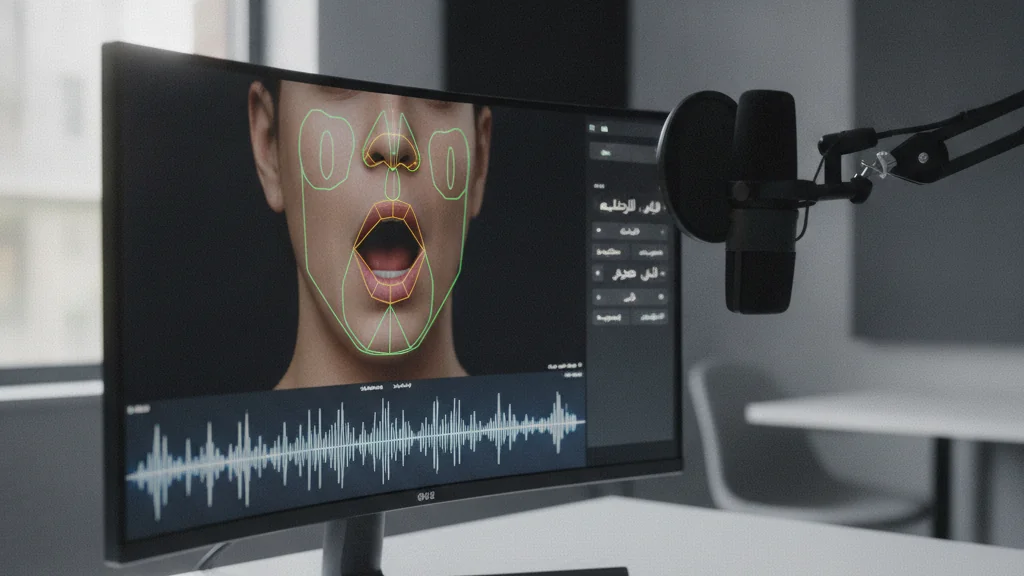
Why Arabic video production needed more than voice cloning
If you have ever tried to adapt a corporate video shot in English into Arabic, you know the pain. You either spend weeks in an ADR studio re-recording every line, or you slap a voiceover on top that never quite matches the speaker's mouth movements. The result looks clumsy, feels unnatural, and often fails to connect with Arabic-speaking audiences in Dubai, Abu Dhabi, or across the region. That is why the launch of DeepSync on June 2, 2026, a real-time AI lip-sync dubbing tool, is changing how video content gets produced for the UAE market.
DeepSync does not just translate audio. It modifies the video itself, frame by frame, so the speaker's lips move in sync with the new Arabic dialogue. It preserves the original emotion, timing, and vocal character. It works in over 30 languages. For anyone working in a post-production suite in Al Quoz or a content studio in twofour54, this matters.
What DeepSync does that voice cloning never could
Most people in the industry have tried ElevenLabs or other voice cloning tools. They can mimic a voice convincingly, which is fine for podcast intros or text-to-speech narration. But they do not touch the video. You are left with an audio file that you have to manually sync to picture, hoping the actor's mouth movements look believable.
DeepSync operates differently. It analyzes the original speaker's facial movements, then generates new mouth shapes that correspond to the phonemes of the target language, in this case Arabic. It does this in real-time for short clips and under 30 minutes for full-length episodes. A 30-second ad for a DIFC fintech brand can be translated and lip-synced in minutes, not weeks. The output is frame-accurate: every syllable matches a visual mouth position.
It is a different category from voice cloning. Think of it as replacing the manual ADR and rotoscoping process with a neural network that understands both speech and facial geometry. For Arabic video production, where regional dialects and Modern Standard Arabic both play important roles, the ability to keep the speaker's original tone while changing the language is a major time-saver.
Why the old dubbing workflow no longer works
Traditional dubbing for corporate or educational content in Dubai typically involves:
- Hiring a voice actor fluent in Arabic (or the target dialect)
- Booking a recording studio in Media City or Al Quoz
- Directing the actor to match the original speaker's timing and emotion
- Editing the audio to fit the waveform in Premiere Pro or DaVinci Resolve
- Manually adjusting the video to hide unsynced mouth movements, or resorting to cutaways
That process usually takes two to four weeks for a 10-minute video. DeepSync can do the same job in under an hour. For brands producing quarterly training modules for their teams across the UAE, or e-learning companies in Dubai Silicon Oasis, that speed changes the math. You can update a video for a new market without reshooting or re-recording anything.
Quality still matters. The tool is best used for talking-head content, presentations, and scripted narration. For dialogue-heavy scenes with multiple speakers or emotional nuance, human oversight is still needed. The baseline quality is already strong, and it is improving quickly.
Dubai brands already running DeepSync for regional versions
Several Dubai-based companies have started testing DeepSync on real projects. A real estate developer in Business Bay used it to translate a client testimonial video from English into Arabic and Hindi, then pushed both versions out on social media within the same week. A fintech startup based in DIFC took their investor pitch deck, originally recorded in English, and produced a lip-synced Arabic version for local partners, without flying in a voice actor or booking a studio in Media City.
Training and e-learning are probably the biggest use cases right now. One logistics company with warehouses in Jebel Ali and Al Quoz maintains a library of safety and onboarding videos. Previously, they had to re-shoot for each language. Now they run the English master through DeepSync, review the Arabic output, and publish. The same applies to corporate communications from HR departments in JLT or Downtown: internal messages, CEO updates, town hall replays can all be localized in a day.
DeepSync's ability to preserve the original speaker's emotion is the part that actually sells internally. A CEO's tone of reassurance or urgency translates into Arabic more naturally when the lips sync correctly. It does not feel like a cheap dub. It feels like the same person speaking the local language.
Deepfake concerns and UAE disclosure requirements
Any tool that modifies video at the pixel level raises red flags around deepfakes. DeepSync is no exception. In the UAE, the UAE New Media Law 2026 for content creators includes specific provisions around synthetic media and AI-generated content. If you use AI to alter someone's speech or appearance, you may be required to label the video as such, especially for news or political content.
For commercial video production, the rules are slightly looser but still demand transparency. If you are creating a dubbed version of a CEO message, the safe move is to include a disclosure such as "This video has been automatically dubbed for accessibility." The UAE's Media Regulatory Office in Dubai Media City has issued best practices that recommend clear labeling when AI has been used to alter a person's words or image.
This is not a dealbreaker. Most brands are comfortable with the disclosure, as long as the quality is high. The rule is to use DeepSync responsibly: do not claim that a celebrity or public figure said something they did not, and do not apply it to manipulated content without consent. For standard corporate, training, and e-learning videos, the risk is low and the benefits outweigh the concerns.
Integration with Premiere Pro and DaVinci Resolve
DeepSync launched with plugins for Adobe Premiere Pro and DaVinci Resolve, which means editors can run the tool directly inside their NLE without exporting and re-importing. For a post-production house in Al Quoz or a freelance editor in JLT, this changes the workflow. You select the clip, choose the target language (Arabic, Urdu, Chinese, French, etc.), hit process, and a few minutes later the timeline reflects the new lip-synced video.
This tight integration also means you can iterate quickly. If the timing feels off on a certain word, you can adjust the audio manually or re-run that section through DeepSync. The plugin handles the heavy lifting of facial mapping and frame analysis, but the editor stays in control of the cut. It works with most standard codecs and resolutions up to 4K, which covers the vast majority of corporate and social media content produced in Dubai.
The enterprise tier also supports batch processing for longer projects. For a production company churning out multiple regional versions of the same ad, that is a real efficiency gain. You can set it up before lunch and come back to finished files.
What to watch out for when adopting DeepSync
No tool is perfect, and DeepSync has its limits. It works best with clear, frontal-facing video where the speaker's face is well-lit and unobstructed. Profiles, fast head turns, or heavy shadows can cause glitches in the lip-sync that require manual correction. For Arabic, the tool handles Modern Standard Arabic and the major Gulf dialects reasonably well, but Levantine or Maghrebi dialects may need more tuning.
Audio quality matters too. If the original recording is noisy or has reverb, the AI can misalign the phonemes with the mouth shapes. Always clean up your audio track before running DeepSync. The emotion preservation is impressive, but it is not a perfect replacement for a talented human voice actor delivering a nuanced performance. For high-end advertising or feature content, you will still want a professional dubbing session in a studio in Media City or twofour54.
That said, for 90% of the corporate, training, e-learning, and social media content produced in Dubai, DeepSync is a reliable, fast, and cost-effective solution. It does not replace the human touch; it frees up time so editors and producers can focus on the creative decisions that actually matter. For a deeper look at how AI-generated voiceovers for Arabic narration compare, or how ElevenLabs v3 Alpha for Arabic AI voiceovers stacks up against DeepSync, those pieces are already on the blog. For a broader view of what this tech means for the production pipeline, AI video production services in the UAE covers the workflow side in more detail. For a primer on the broader technology of automated dubbing, the Wikipedia overview of dubbing in filmmaking is a useful reference.