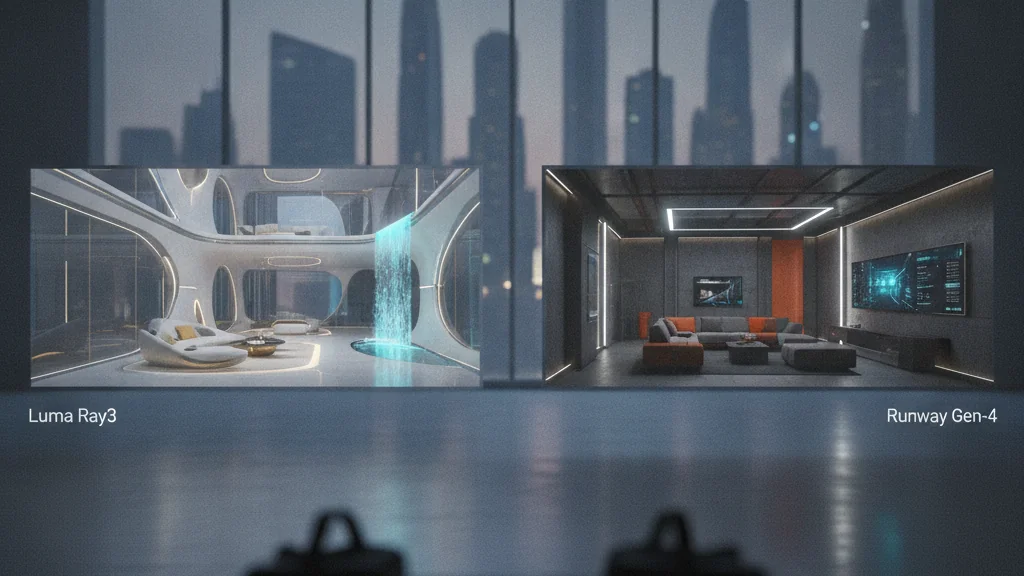
Why AI property video changed the off-plan pitch
Dubai's off-plan market runs on visuals. Buyers in Business Bay, Dubai Marina and Jumeirah sign on apartments that do not exist yet, so the render is the only thing they can actually look at. Traditional 3D architectural renders give you a still frame. They do not give you the walk from the lift lobby to the balcony at golden hour, with the skyline filling the window. That gap is where AI property video steps in: an architect's Revit model or SketchUp file becomes a moving camera path, and the buyer sees the flow of the space rather than a static corner of it.
For a Dubai production team this matters commercially. A two-bedroom in Business Bay that is still on the drawing board cannot be photographed, but it can absolutely be walked through. Developers selling off-plan inventory need that walkthrough before handover, which is typically two to three years out. AI video production shortens that gap from "wait for construction" to "show it now".
Where AI property video actually costs you money
Traditional CGI walkthroughs are expensive because the labour is the cost. Three weeks of animator time on a single 90-second sequence, plus lighting and look development, lands anywhere from AED 40,000 to AED 80,000 for a full apartment tour. AI video generators compress that. They are not free and they are not magic, but a model-driven render that takes an afternoon instead of a month changes which projects are worth quoting at all.
There is a second saving that is easier to miss. Agencies producing off-plan launch films no longer have to re-shoot when a buyer asks for a second unit layout. The model is the master; every variant is a re-render, not a new production.
Luma Ray3: photorealism driven by the 3D model
Luma Ray3's strength is that it is model-driven. You feed it geometry, not a sentence. If a developer already has an accurate Revit or 3ds Max model of a Jumeirah villa, Ray3 renders a real camera path through that geometry. The output inherits the actual dimensions, window positions and floor plan, which is exactly what a developer selling accuracy needs.
That precision comes with a constraint: garbage in, garbage out. If the 3D model is roughly blocked out, with placeholder furniture and no lighting rig, Ray3 will faithfully render a roughly blocked-out apartment. Teams using Ray3 successfully spend their time on the model first and the prompt second. Luma's own Ray3 documentation is worth reading before a production, because it sets out which input formats the model handles cleanly and where it still needs manual cleanup.
Runway Gen-4: speed and flexibility before the model exists
Runway Gen-4 works the other way round. It takes text and image prompts and produces video, which makes it the right tool for the stage where the property is still a concept. A marketing team that needs four mood options for a Business Bay penthouse by Friday, before the architect has signed off on materials, can iterate on Runway Gen-4 in an afternoon.
What you get is stylistically convincing and spatially approximate. The sofa might be in the wrong place relative to the approved floor plan. That is fine for internal pitch decks and launch teasers. It is not fine for the final marketing film a developer signs off, because the buyer compares the video against the handover unit.
Luma Ray3 vs Runway Gen-4 for apartment walkthroughs
The comparison comes down to one question: does the approved 3D model exist yet?
If it does, Ray3 wins on accuracy. A walkthrough rendered from final geometry cannot contradict the building, and the same footage can support the handover documentation later. If it does not, Runway Gen-4 wins on speed. You cannot render a walkthrough through a building that has not been modelled, but you can show a buyer what the mood is meant to be.
Most Dubai agencies end up using both. Gen-4 builds the concept, the developer signs off the direction, Ray3 renders the real thing. Agencies already running this pattern for construction progress and pre-sale films treat the AI pass as one stage in a longer pipeline rather than the whole delivery.
What still needs a human in the pipeline
Neither tool delivers broadcast-ready footage on its own. The work that remains is post-production: colour grading, sound design, motion graphics for the amenity callouts, and a licence-safe music bed. A raw AI render in a Dubai sales centre is noticeable precisely because the audience has seen thousands of professionally finished property films.
Audio carries more weight than teams expect. Arabic and English voiceovers, room tone under the dialogue, and a low ambient bed do more to sell a space than another 4K of resolution. Voice work for UAE projects is worth budgeting for separately, and the same post team should handle it so the mix stays coherent.
Most teams running this hybrid approach book the model-driven stage and the finish as one engagement rather than two. If you want the post-production and finishing handled in-house alongside the render, The video production service covers both stages under one schedule.
The practical takeaway for a developer briefing an agency: ask which tool runs on your actual model, and ask what happens to the footage in post. A production house that answers both precisely is the one that will deliver on schedule.